No products in the cart.
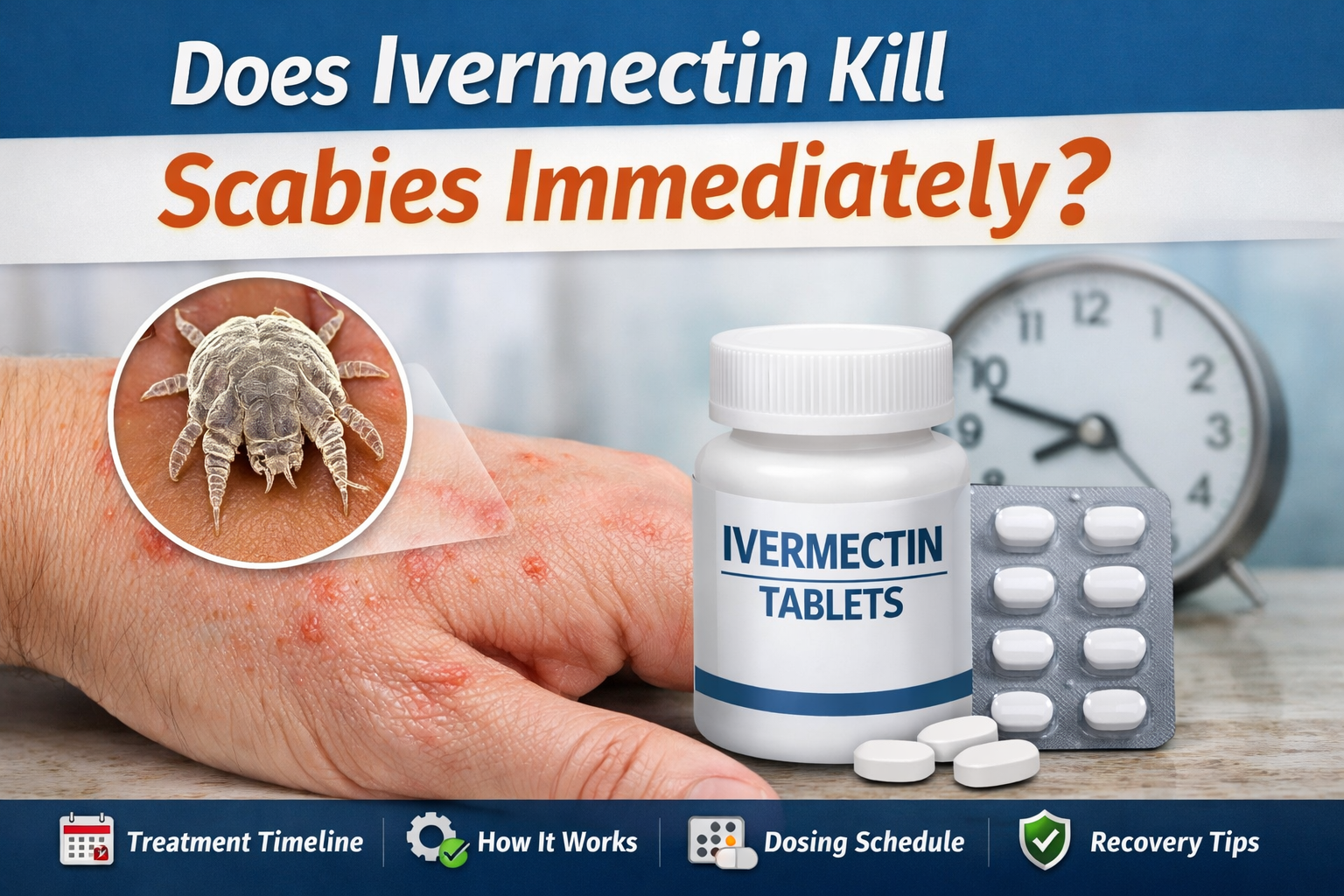


Scabies is a common but highly distressing skin condition caused by the microscopic mite Sarcoptes scabiei, and it affects millions of people worldwide each year. The infestation leads to relentless itching, inflamed skin rashes, redness, and intense discomfort that often worsens at night, disturbing sleep and daily life. As symptoms rapidly impact physical comfort and emotional well-being, many patients urgently search for fast and effective treatment options and frequently ask: does ivermectin kill scabies immediately, or does it take time to work? Understanding how ivermectin works for scabies, how quickly it affects mites, and what to expect after treatment is essential for achieving complete recovery and avoiding reinfestation.
Does ivermectin kill scabies immediately?
This question is understandable—but the answer requires medical clarity. While ivermectin is a proven and effective treatment for scabies, it does not eliminate the infestation instantly. Understanding how ivermectin works, how long it takes to show results, and what to expect during recovery is essential for successful treatment and preventing reinfection.
This in-depth guide explains everything you need to know, following Google’s medical (YMYL) and Helpful Content guidelines, with accurate, evidence-based information written for real people—not bots.
Scabies occurs when female mites burrow into the outer layer of human skin to live, feed, and lay eggs. Each mite lays multiple eggs during its lifespan, which later hatch and continue the cycle.
Mites live under the skin, not on the surface
Eggs hatch in 3–4 days
The immune system reacts strongly to mites and their waste
Symptoms often appear weeks after infestation
This delayed immune response explains why scabies often spreads unknowingly and why treatment takes time to fully work.
Ivermectin is an oral antiparasitic medication used worldwide for treating parasitic infections. Although originally developed for other parasites, it has become an important option for scabies treatment, especially in moderate to severe cases.
Systemic action (works throughout the body)
Useful when topical treatments fail
Effective in outbreaks and institutional settings
Helpful for crusted (Norwegian) scabies
Easier to administer than full-body creams
Ivermectin is commonly prescribed off-label for scabies, supported by strong clinical evidence and international treatment guidelines.
No, ivermectin does not kill scabies immediately.
This is one of the most important points to understand.
Paralyzes and kills adult scabies mites
Does not kill scabies eggs
Takes time to circulate and act systemically
Requires repeat dosing
Because scabies eggs survive the first dose, ivermectin treatment is intentionally structured over time.
Understanding the treatment timeline helps prevent panic and unnecessary retreatment.
Day 1–2
Medication enters bloodstream
Adult mites begin to lose mobility
No immediate symptom relief for most patients
Day 3–5
Adult mites die
Itching may continue or temporarily worsen
Skin inflammation remains active
Day 7–10
Eggs from before treatment may hatch
New mites can appear if no second dose is taken
Day 10–14
Second dose eliminates remaining mites
No new infestation cycle continues
Week 2–4
Skin gradually heals
Post-scabies itching may persist
No live mites remain
👉 This delayed response is normal and expected.
Many people assume that if itching continues, the treatment has failed. This is not medically accurate.
Allergic reaction to dead mites
Immune response remains active
Residual mite debris under skin
Skin barrier damage needs time to heal
Post-treatment itching can last 2–4 weeks, and sometimes longer, even when scabies is completely cured.
Doctors refer to this as post-scabetic pruritus, and it does not mean reinfestation.
⚠️ Always follow medical advice. Do not self-medicate.
200 micrograms per kg of body weight
Taken orally with water
Usually on an empty stomach
Second dose after 7–14 days
The second dose is essential because ivermectin does not affect eggs. Missing it is one of the most common reasons scabies returns.
In most cases, no.
Clinical studies consistently show that two doses are significantly more effective than one. A single dose may reduce symptoms but often fails to fully eliminate the infestation.
Crusted scabies
Severe or long-standing infestations
Immunocompromised patients
Institutional outbreaks
These decisions must always be made by a healthcare professional.
The most common topical treatment for scabies is permethrin 5% cream. Both treatments have their place.
| Feature | Ivermectin (Oral) | Permethrin (Topical) |
|---|---|---|
| Method | Systemic | Surface application |
| Kills adult mites | Yes | Yes |
| Kills eggs | No | Partial |
| Ease of use | High | Moderate |
| Best for outbreaks | Yes | Limited |
| Crusted scabies | Preferred | Often insufficient |
Many dermatologists recommend combination therapy for faster and more reliable results.
Medication alone is not enough.
Wash clothes, towels, and bedding in hot water
Dry on high heat
Seal non-washable items for at least 72 hours
Vacuum furniture and mattresses
Treat all close contacts at the same time
Scabies spreads through prolonged skin contact. Without proper prevention, reinfestation is common.
Ivermectin is generally safe when prescribed correctly, but it is not suitable for everyone.
Mild dizziness
Nausea
Headache
Fatigue
Are pregnant or breastfeeding
Have liver disease
Are taking interacting medications
Are treating young children
Never exceed the prescribed dose.
No. Adult mites die over 1–3 days, and full eradication requires repeat dosing.
This is due to the immune response to dead mites, not active infestation.
Yes, if the second dose is missed or contacts are untreated.
It must be prescribed by a healthcare provider and used with caution in certain populations.
No—ivermectin does not kill scabies immediately, but it is one of the most effective treatments available when used correctly.
Successful treatment depends on:
Correct weight-based dosing
A mandatory second dose
Treating close contacts
Proper hygiene and prevention measures
When these steps are followed, ivermectin provides safe, reliable, and lasting relief from scabies.
This content is for educational purposes only and does not replace professional medical advice. Always consult a licensed healthcare provider before starting or changing treatment.

Always available!

With 100 letters custom note

9:00 - 20:00, 7 days/week


Leave a comment