


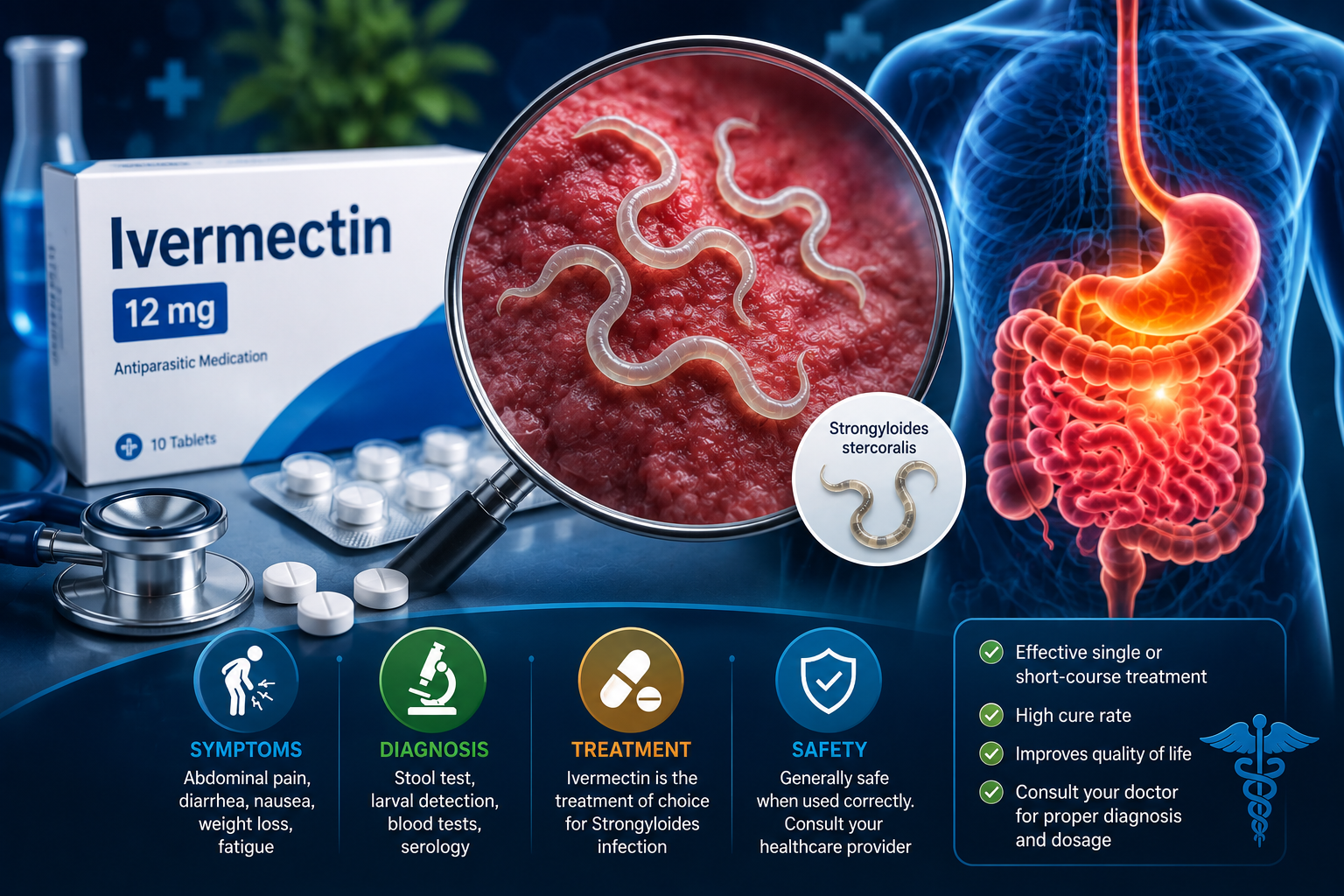
Ivermectin for Strongyloides: Symptoms, Diagnosis, Treatment & Safety Guide
Ivermectin for Strongyloides is an important treatment topic because strongyloidiasis is a parasitic infection that can persist for years and, in certain circumstances, become a serious medical condition. Strongyloidiasis is caused primarily by Strongyloides stercoralis, a parasitic roundworm that can live in the human intestine. The infection is particularly important to recognize because some people have few or no symptoms, while others can develop gastrointestinal, skin, or respiratory problems.
The infection is more common in tropical and subtropical regions and can also occur elsewhere. It is acquired when infective larvae in contaminated soil penetrate the skin, often through bare feet. Unlike many other intestinal parasites, Strongyloides can maintain an autoinfection cycle inside the body, allowing infection to persist for many years without treatment.
This guide explains what Strongyloides infection is, common symptoms, how doctors diagnose it, the role of ivermectin in treatment, important safety considerations, and why medical evaluation matters.
Medical disclaimer: This article is for general educational purposes and is not a substitute for diagnosis or treatment from a qualified healthcare professional. Ivermectin should be used only when medically appropriate and according to professional guidance.
What Is Strongyloidiasis?
Strongyloidiasis is an infection caused mainly by the parasitic worm Strongyloides stercoralis. It is classified as a soil-transmitted helminth infection and is found predominantly in tropical and subtropical regions, although infections can occur in temperate areas as well.
One unusual characteristic of Strongyloides is its ability to reinfect the same person internally. This process, called autoinfection, means an untreated infection may persist for years or even throughout a person’s lifetime.
Many infections produce mild or no obvious symptoms. This makes awareness and appropriate testing especially important in people who have lived in or traveled extensively through areas where Strongyloides is common.
How Does Strongyloides Infection Spread?
The parasite generally spreads through contact with contaminated soil.
Infected people can pass parasite larvae in their stool. In areas where sanitation is inadequate, contaminated soil can become a source of infection. Infective larvae can then penetrate human skin.
Potential exposure can occur through activities such as:
- Walking barefoot on contaminated soil
- Agricultural or outdoor work
- Recreational contact with contaminated ground
- Living in areas where sanitation infrastructure is limited
The larvae can enter through the skin and eventually reach the intestine, where the parasite continues its life cycle.
Common Symptoms of Strongyloidiasis
Some people with Strongyloides infection have no noticeable symptoms. When symptoms occur, they can vary considerably.
Gastrointestinal symptoms
Possible digestive symptoms include:
- Abdominal discomfort or pain
- Diarrhea
- Intermittent gastrointestinal symptoms
- Nausea or digestive upset in some patients
Skin symptoms
Skin manifestations can include:
- Itching
- Rash
- Hives or urticaria
- Recurrent skin irritation
Respiratory symptoms
Because the parasite migrates through the body during its life cycle, some people may experience respiratory symptoms such as:
- Cough
- Wheezing
- Breathing-related discomfort
The World Health Organization notes that strongyloidiasis can present with intestinal, pulmonary, or skin symptoms, while some infected individuals remain asymptomatic.
Why Can Strongyloidiasis Become Serious?
For many people, chronic strongyloidiasis may cause relatively mild symptoms. However, the infection can become dangerous when the body’s immune defenses are significantly weakened.
A major concern is hyperinfection syndrome or disseminated strongyloidiasis. These severe forms can occur particularly in people receiving certain immunosuppressive medications or who have conditions that impair immune function. WHO reports that disseminated disease has a case-fatality rate exceeding 60%.
This is one reason identifying Strongyloides infection before significant immunosuppression can be clinically important.
People who have a history of residence or prolonged travel in endemic areas should tell their healthcare provider about that history, particularly before starting treatments that may suppress the immune system.
How Is Strongyloides Diagnosed?
Diagnosis can be challenging because routine testing may not always detect the infection.
Doctors may consider several approaches, depending on the person’s symptoms, exposure history, and clinical circumstances.
Stool testing
Stool examination can be used to look for evidence of Strongyloides infection. Specialized techniques may improve detection compared with a basic stool examination. WHO identifies methods such as Baermann techniques and agar plate culture as important diagnostic approaches.
Serology
Blood tests that detect antibodies against Strongyloides may also be useful, particularly in certain patients with suspected chronic infection.
Molecular testing
Polymerase chain reaction (PCR) testing may be available in some clinical or laboratory settings and can provide another diagnostic option.
Because no single test is perfect in every circumstance, healthcare professionals may use the patient’s medical history, exposure history, symptoms, and laboratory findings together.
Ivermectin and Strongyloides Treatment
Ivermectin has an established role in the treatment of chronic strongyloidiasis. WHO describes oral ivermectin as the standard treatment for chronic S. stercoralis infection.
The goal of treatment is to eliminate the parasite and prevent continued autoinfection and potential complications.
Treatment decisions should be individualized. The appropriate regimen can depend on factors such as:
- Confirmed or suspected infection
- Severity of disease
- Age and body weight
- Pregnancy status
- Other medical conditions
- Current medications
- Potential exposure to other parasites
- Whether the infection is uncomplicated or severe
WHO’s guideline describes oral ivermectin at 200 micrograms per kilogram as the standard treatment approach for chronic strongyloidiasis, with treatment duration depending on the clinical situation.
This information should not be interpreted as a recommendation for self-treatment. A healthcare professional should determine whether ivermectin is appropriate and what regimen should be used for an individual patient.
Ivermectin for Strongyloides: Why Medical Guidance Matters
Although ivermectin is widely used as an antiparasitic medicine, the correct treatment is not simply a matter of choosing a tablet strength.
Healthcare professionals need to consider the diagnosis, patient’s weight, medical history, other medications, and potential contraindications.
There is also an important distinction between treatment of an individual patient and public-health programs.
For example, WHO recommends annual mass administration of a single ivermectin dose in certain endemic settings where S. stercoralis prevalence meets a specified threshold. That public-health recommendation is not the same thing as individualized treatment for someone who suspects they have a parasite infection.
Important Ivermectin Safety Considerations
Ivermectin is generally well tolerated when appropriately prescribed, but it is not suitable for everyone.
Before treatment, patients should tell their healthcare professional about:
- Pregnancy or plans to become pregnant
- Breastfeeding
- Liver or other significant medical conditions
- Current prescription and nonprescription medicines
- Previous reactions to medications
- Travel or residence in areas where other parasites are common
Particular caution may be necessary when Loa loa infection is possible. WHO has highlighted the importance of considering potential Loa loa infection because ivermectin can cause serious neurological complications in heavily infected individuals.
Age and body weight are also important considerations. Treatment recommendations for children should come from a healthcare professional rather than being calculated independently.
Possible Side Effects
Like other medicines, ivermectin can cause adverse effects.
Depending on the individual and the underlying infection, possible reactions can include:
- Dizziness
- Nausea
- Diarrhea
- Abdominal discomfort
- Fatigue
- Headache
- Skin reactions
Some reactions may relate to the body’s response to dying parasites rather than direct toxicity from the medicine.
Severe or unusual symptoms should receive prompt medical attention.
Patients should not increase, repeat, or combine doses on their own simply because symptoms continue. Persistent symptoms may mean that additional evaluation is needed rather than more medication.
Strongyloides and Steroid Treatment
One of the most important safety issues surrounding Strongyloides is the relationship between chronic infection and immunosuppressive treatment.
Corticosteroids and other immunosuppressive therapies can increase the risk of severe Strongyloides disease in susceptible individuals. WHO specifically highlights the risk of hyperinfection and disseminated disease in people receiving immunosuppressive medications such as steroids.
If someone has lived in or traveled extensively through an endemic region and is going to begin significant immunosuppressive therapy, discussing Strongyloides risk with the treating clinician can be important.
Can Strongyloides Go Away Without Treatment?
Strongyloides can be different from many short-lived intestinal infections because of its autoinfection cycle.
Without appropriate treatment, chronic infection can persist for years or even a lifetime.
For this reason, people with confirmed infection should discuss treatment and follow-up with a qualified healthcare professional rather than assuming that symptoms will eventually disappear.
How Can Strongyloides Infection Be Prevented?
Prevention focuses largely on reducing contact with contaminated soil and improving sanitation.
Helpful measures include:
- Wearing shoes outdoors
- Avoiding unnecessary direct contact with potentially contaminated soil
- Following appropriate hygiene practices
- Supporting proper sanitation and sewage disposal
- Seeking medical advice after relevant exposure when symptoms develop
- Informing healthcare providers about previous residence or extensive travel in endemic areas
WHO emphasizes sanitation and hygiene as important elements in controlling soil-transmitted helminth infections.
When Should You See a Doctor?
Consider medical evaluation if you have persistent gastrointestinal, skin, or respiratory symptoms and have previously lived in or traveled extensively through an area where Strongyloides is common.
Medical evaluation is especially important if you:
- Have a confirmed Strongyloides infection
- Are preparing to start corticosteroids or other immunosuppressive treatment
- Have unexplained recurring gastrointestinal symptoms
- Have persistent unexplained skin symptoms after relevant exposure
- Have a history of prolonged residence in an endemic area
- Develop severe symptoms after known or suspected parasitic infection
Severe breathing difficulties, confusion, significant weakness, or other rapidly worsening symptoms require urgent medical assessment.
Frequently Asked Questions
What is Strongyloides?
Strongyloides is a parasitic roundworm, most commonly Strongyloides stercoralis, that can infect humans and cause strongyloidiasis.
Is ivermectin used for Strongyloides?
Yes. Oral ivermectin is an established treatment for chronic strongyloidiasis and is identified by WHO as the standard treatment.
Can Strongyloides infection have no symptoms?
Yes. Many infections are asymptomatic or produce only mild, intermittent symptoms, which can make diagnosis difficult.
What are common Strongyloides symptoms?
Possible symptoms include abdominal discomfort, diarrhea, itching, urticaria, cough, and wheezing. Some people have no symptoms.
Can Strongyloides become dangerous?
Yes. Severe hyperinfection or disseminated strongyloidiasis can occur, particularly in people with weakened immune systems. These complications can be life-threatening.
Can I take ivermectin without a diagnosis?
Self-treatment is not recommended. A healthcare professional should determine whether Strongyloides is actually present and whether ivermectin is appropriate.
Is one negative stool test enough to rule out Strongyloides?
Not necessarily. Diagnostic sensitivity varies, and healthcare professionals may use specialized stool techniques, serology, PCR, or repeated testing depending on the circumstances.
Read more: How Doctors Diagnose Parasitic Infections Before Prescribing Treatment
Strongyloidiasis deserves attention because it can remain hidden for years while maintaining an autoinfection cycle. Although many infections are mild or asymptomatic, severe disease can occur, particularly when immune defenses are suppressed.
Ivermectin for Strongyloides has an established role in treating chronic infection, but the appropriate treatment plan should be based on professional medical assessment rather than self-diagnosis or self-dosing. Proper diagnosis, consideration of risk factors, and appropriate follow-up are essential for safe management.
For website content, this article should be positioned as an educational parasite-treatment guide, with links to reputable sources such as WHO and other public-health authorities rather than presenting medication as a substitute for professional medical care.


