


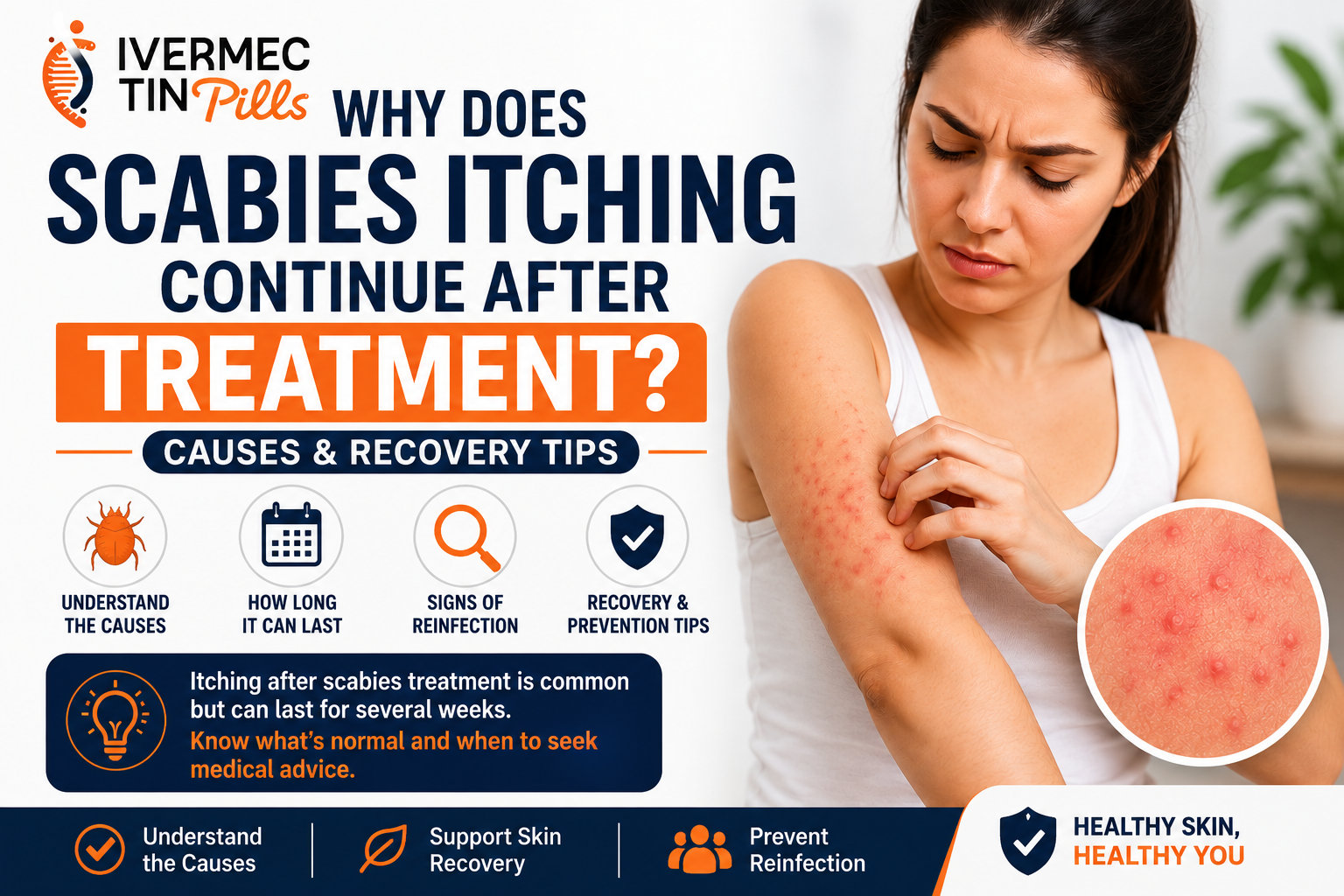
Why Does Scabies Itching Continue After Treatment? Causes & Recovery Tips
Scabies is well known for causing intense itching, particularly at night. But one of the most confusing parts of recovery is that itching after scabies treatment may continue even after the medicine has successfully killed the mites. This does not automatically mean that treatment has failed.
The itching associated with scabies is partly caused by the body’s immune reaction to the mites, their eggs, and material left behind in the skin. Because that immune response can take time to settle, some people continue to experience itching and a rash for several weeks after treatment.
However, persistent or worsening symptoms should not simply be ignored. New burrows, new pimple-like bumps, or symptoms that continue beyond the expected recovery period can indicate reinfestation, treatment failure, or another skin condition.
What Causes Scabies Itching?
Scabies occurs when the human itch mite, Sarcoptes scabiei, burrows into the upper layer of the skin. The body’s immune system reacts to the mites and their eggs and feces, producing the characteristic intense itching and rash.
The itching can be particularly severe at night and may interfere with sleep. Scratching can also damage the skin, creating sores that may become infected with bacteria.
Importantly, killing the mites does not mean that the skin immediately returns to normal. The inflammatory and allergic response can take additional time to settle.
Why Does Itching Continue After Treatment?
1. Your Immune Response Takes Time to Settle
One of the most common explanations is that your immune system is still reacting to remnants of the infestation.
The CDC explains that scabies itching results from a hypersensitivity reaction to mites and their feces. Consequently, itching can continue for several weeks even when the mites and eggs have been killed.
This is sometimes described as post-scabies itch.
The important point is that persistent itching alone does not prove that live mites are still present.
2. Your Skin May Still Be Inflamed
Scabies can cause significant irritation, particularly when someone has been scratching repeatedly.
Even after successful treatment, the affected skin may remain irritated while it repairs itself. The American Academy of Dermatology notes that rash and itching can temporarily worsen during treatment, and skin healing can take time.
Avoiding excessive scratching is therefore important because scratching can further damage the skin and potentially increase the risk of infection.
3. Treatment May Not Have Been Completed Correctly
Scabies treatment needs to be used exactly as directed by a healthcare professional.
For topical medicines, application instructions matter. Missing areas of skin, washing medication off too early, or not following repeat-treatment instructions when prescribed can contribute to treatment failure.
The AAD recommends following the dermatologist’s instructions carefully and notes that applying treatment more often than directed can actually worsen irritation and itching.
4. Someone Close to You May Still Have Scabies
Scabies can spread through prolonged, direct skin-to-skin contact. Household members and other close contacts may have the infestation without immediately showing symptoms.
If an infected person receives treatment but close contacts are not evaluated and treated when appropriate, reinfestation can occur.
This is why managing scabies often involves more than treating one person’s skin.
5. Bedding and Clothing Can Play a Role
Although human scabies mites generally survive only a few days away from human skin, contaminated clothing, towels, and bedding can contribute to transmission or reinfestation.
The CDC recommends washing bedding, clothing, and towels in hot water and drying them using a hot dryer. Items that cannot be washed can be dry-cleaned or sealed in a plastic bag for an appropriate period.
Good household hygiene during treatment can therefore be an important part of preventing another exposure.
6. The Original Diagnosis May Need to Be Reconsidered
Not every itchy rash is scabies.
Conditions such as eczema, dermatitis, allergic reactions, fungal infections, insect bites, and other skin disorders can cause itching. The AAD notes that persistent itch can have many causes, making accurate diagnosis important.
If your symptoms are not improving as expected, a healthcare professional can determine whether ongoing scabies, another skin condition, or irritation from treatment is responsible.
How Long Can Scabies Itching Last After Treatment?
There is no single recovery timeline that applies to everyone.
The CDC states that itching may continue for several weeks after successful treatment. It recommends contacting a healthcare professional if itching remains two to four weeks after treatment, particularly when accompanied by new burrows or a new pimple-like rash.
The American Academy of Dermatology similarly explains that the rash and itch can persist during the healing process and that skin may take several weeks to recover.
Therefore, the direction of your symptoms matters.
Gradual improvement is generally more reassuring than progressively worsening itching accompanied by new lesions.
Signs That Treatment May Be Working
While every person’s recovery is different, some changes may suggest that the infestation is resolving:
- Itching gradually becomes less intense.
- No new burrows are appearing.
- Fewer new bumps are developing.
- Existing skin lesions begin to heal.
- Sleep gradually improves as nighttime itching decreases.
- The skin becomes less irritated over time.
It is important to remember that itching can remain even after the mites have been eliminated because the immune response does not disappear instantly.
Signs That You May Need Medical Follow-Up
Persistent itching deserves further evaluation when it is accompanied by signs suggesting continued infestation, reinfection, treatment failure, or infection.
Contact a healthcare professional if:
- New burrows appear.
- New pimple-like rashes continue developing.
- Itching remains significant two to four weeks after treatment.
- Symptoms are becoming worse instead of gradually improving.
- Other household members develop symptoms.
- Scratching has caused open sores.
- The skin becomes increasingly painful, swollen, warm, or develops signs of infection.
The CDC specifically recommends medical follow-up when itching persists beyond two to four weeks or when new burrows or pimple-like rashes appear.
How Can You Reduce Itching During Recovery?
Once appropriate scabies treatment has been completed, the goal is to allow the skin to recover while avoiding additional irritation.
Follow Your Treatment Instructions
Use prescribed scabies medication exactly as directed. Do not repeatedly apply treatment simply because itching continues.
The AAD warns that treating the skin more frequently than instructed can worsen rash and itching.
Avoid Excessive Scratching
Scratching may provide temporary relief but can damage the skin.
Repeated scratching can create open sores, which can become infected.
Keeping fingernails short and using gentle skin-care practices can help reduce accidental skin damage.
Keep Skin Care Gentle
During recovery, avoid unnecessarily harsh products that may further irritate already sensitive skin.
A gentle routine can help support the skin barrier while inflammation settles.
Keep Bedding and Clothing Clean
Wash clothing, towels, and bedding according to public-health guidance during treatment. The CDC recommends hot washing and hot drying where appropriate, while non-washable items can be sealed or dry-cleaned.
Ask a Healthcare Professional About Itch Relief
Depending on your symptoms and medical history, a healthcare professional may recommend treatments specifically aimed at controlling itching.
The AAD notes that clinicians may use options such as antihistamines, pramoxine lotion, or topical corticosteroids in selected patients to help control symptoms.
Do not start prescription treatments on your own without appropriate medical advice.
Can You Get Scabies Again After Treatment?
Yes. Completing treatment does not make someone permanently immune to scabies.
Reinfestation can occur following another exposure to someone who has untreated scabies. This is one reason close contacts should be evaluated and treated when appropriate.
The AAD recommends that people who have had close contact with someone diagnosed with scabies receive appropriate evaluation and treatment, even when they do not yet have symptoms.
This is especially important because people experiencing their first scabies infestation may not develop symptoms immediately.
Is Persistent Itching Always a Sign of Live Mites?
No.
This is one of the most important things to understand about scabies recovery.
The immune response triggered by the mites can continue after successful treatment. Therefore, itching by itself does not necessarily mean that live mites remain on the skin.
However, persistent itching combined with new burrows or new pimple-like lesions is more concerning and warrants medical evaluation.
A healthcare professional can assess whether retreatment is appropriate rather than relying on itching alone.
What Should You Avoid During Scabies Recovery?
Some approaches can make irritated skin worse or delay appropriate care.
Avoid:
- Applying scabies medication more frequently than instructed.
- Using agricultural or veterinary pesticides on your skin.
- Using insecticide sprays or fumigants on your body or living space as a scabies treatment.
- Scratching until the skin bleeds.
- Assuming every itchy rash is scabies.
- Ignoring new burrows or new lesions.
- Treating pets for human scabies.
The CDC specifically advises against insecticide sprays and fumigants for scabies and notes that human scabies mites do not require treatment of pets.
When Should You See a Doctor?
Consider medical evaluation if you are uncertain whether your scabies treatment worked or if your symptoms are not following an improving pattern.
You should seek professional advice particularly when:
Itching lasts beyond two to four weeks:
Persistent symptoms may require assessment for treatment failure, reinfestation, or another skin condition.
New burrows appear:
New burrows can indicate ongoing infestation and should be evaluated.
New bumps continue appearing:
A new pimple-like rash after treatment can warrant reassessment.
Skin sores develop:
Repeated scratching can damage the skin and allow bacterial infection to develop.
Symptoms are severe or worsening:
Significant worsening should not simply be attributed to normal recovery.
Frequently Asked Questions
How long does itching last after scabies treatment?
Itching can continue for several weeks after successful treatment because the body’s immune reaction to mites and their debris can persist. If significant itching remains two to four weeks after treatment, particularly with new lesions, contact a healthcare professional.
Does itching mean scabies treatment failed?
Not necessarily. Itching alone does not prove that live mites remain. However, new burrows or new pimple-like rashes may indicate ongoing infestation or reinfestation and should be evaluated.
Why is scabies itching worse at night?
Nighttime itching is a classic feature of scabies. The condition commonly causes intense nighttime pruritus, although the exact experience can vary from person to person.
Can scratching make scabies worse?
Scratching does not necessarily increase the number of mites, but it can further irritate the skin and create sores. Those sores can become infected with bacteria.
Should I repeat scabies treatment if I am still itching?
Do not automatically repeat treatment just because you are itchy. Persistent itching can occur after successful treatment, and unnecessary or excessive treatment can irritate the skin. Speak with a healthcare professional if symptoms persist or new lesions develop.
Can family members cause scabies to come back?
Yes. If someone with scabies remains untreated, close contact can result in reinfestation. Close contacts should be evaluated and treated according to healthcare guidance.
Read more: Can Parasite Infections Come Back After Treatment? Causes, Warning Signs & Prevention
Final Thoughts
Scabies recovery does not always mean that itching disappears immediately. Itching after scabies treatment can continue for several weeks because the immune system may remain sensitive to material left behind by the mites. Gradual improvement is generally more reassuring than persistent or worsening symptoms.
At the same time, ongoing itching should not automatically be dismissed. New burrows, new pimple-like rashes, worsening symptoms, or significant itching that continues two to four weeks after treatment should prompt medical evaluation.
The safest approach is to follow the prescribed treatment instructions, avoid excessive scratching and unnecessary re-treatment, manage clothing and bedding appropriately, and seek professional advice when recovery does not follow an improving pattern.
Disclaimer: This article is for general educational purposes only and is not a substitute for diagnosis or individualized medical advice. Scabies treatment should be determined by a qualified healthcare professional based on the patient’s age, medical history, symptoms, and clinical findings.


