


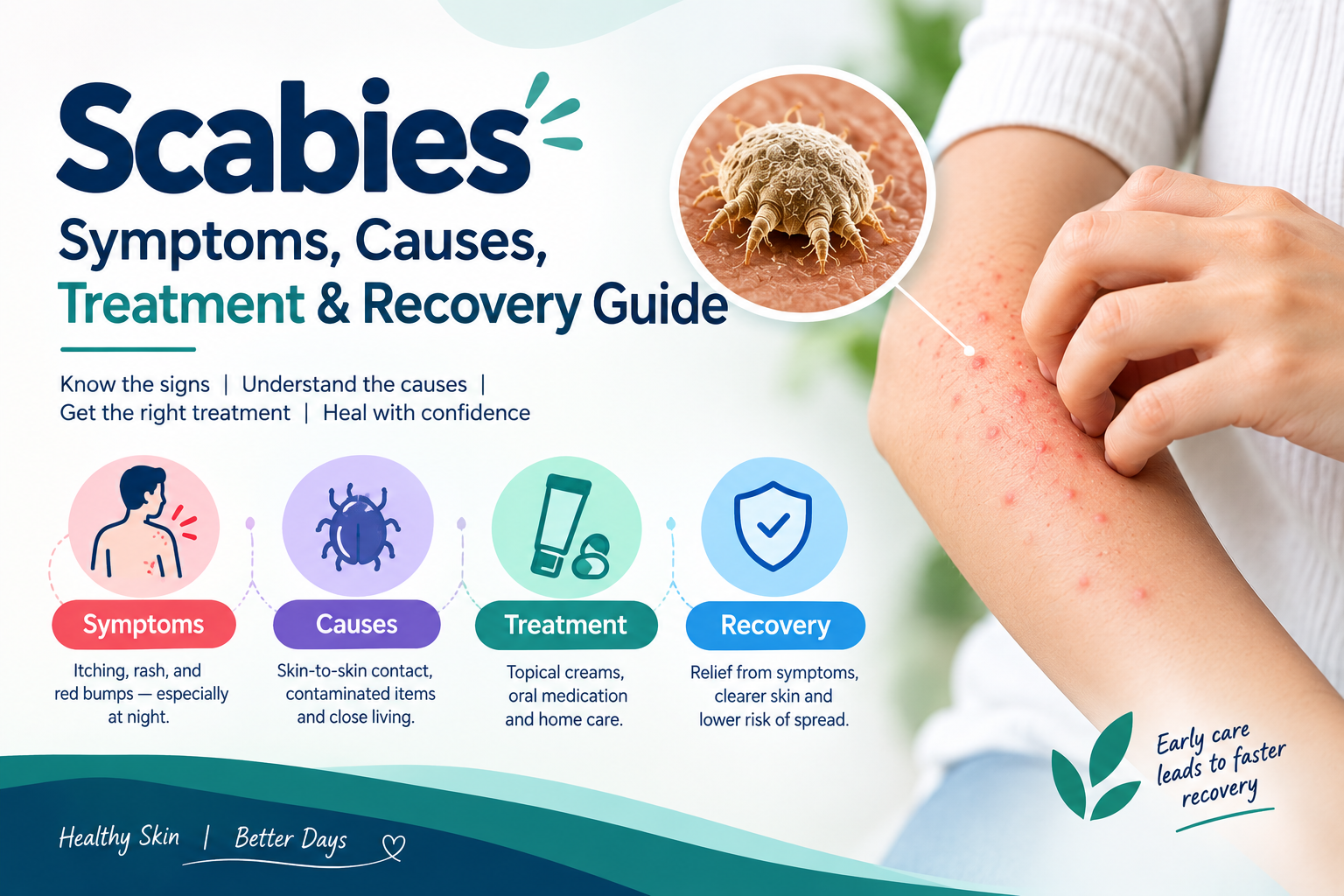
Scabies Symptoms, Causes, Treatment & Recovery Guide
Scabies is a contagious skin infestation caused by a microscopic mite called Sarcoptes scabiei var. hominis. It can affect people of any age and commonly causes intense itching and a pimple-like rash. The itching is often worse at night, and the rash may appear between the fingers, around the wrists, waist, buttocks, armpits, and other areas of the body.
Although scabies is treatable, recognizing the symptoms early and following the recommended treatment plan can help reduce transmission and prevent complications. Because several skin conditions can look similar, people who suspect scabies should seek evaluation from a healthcare professional rather than relying only on symptoms.
This guide explains scabies symptoms and treatment, how scabies spreads, how it is diagnosed, available treatment approaches, recovery, prevention, and when medical attention is important.
What Is Scabies?
Scabies is an infestation of the skin by the human itch mite. After coming into contact with a person who has scabies, a female mite can burrow into the upper layer of the skin and lay eggs. The body’s immune response to the mites, eggs, and their waste products causes the characteristic itching and rash.
Scabies can spread through prolonged, direct skin-to-skin contact. It is more likely to spread among people who live together or have close physical contact. Outbreaks can also occur in crowded settings.
Importantly, having scabies does not mean that someone has poor hygiene. Anyone can develop the condition.
Common Scabies Symptoms
The most recognizable symptoms are intense itching and an itchy rash. Itching may become particularly uncomfortable at night.
Common symptoms include:
- Intense or persistent itching
- Itching that becomes worse at night
- Small, pimple-like bumps
- Red or irritated areas of skin
- Thin, raised burrow lines
- Rash between the fingers
- Irritation around the wrists and elbows
- Rash around the waist, buttocks, or armpits
- Lesions around the nipples or genital area
Scabies can look different depending on age and individual circumstances. Infants and very young children may have affected areas on the head, face, neck, palms, and soles of the feet.
When Do Scabies Symptoms Appear?
The timing can vary, particularly depending on whether someone has had scabies before.
For a first infestation, symptoms may take several weeks to appear. CDC notes that symptoms can take around three to six weeks after initial infestation, while people who have previously had scabies may develop symptoms much sooner after a new exposure.
A person can also spread scabies before obvious symptoms develop. This is one reason close contacts may need evaluation or treatment even when they do not currently have an itchy rash.
Where Does Scabies Usually Appear?
Scabies can affect different areas of the body. Common locations include:
- Between the fingers
- Wrists
- Elbows
- Knees
- Armpits
- Waist
- Buttocks
- Shoulder blades
- Genital area
- Nipples
In young children, the scalp, face, palms, and soles may also be involved.
The presence of an itchy rash in one of these areas does not automatically confirm scabies. Eczema, allergic reactions, insect bites, and other skin conditions can produce similar symptoms.
What Causes Scabies?
Scabies is caused by the human itch mite, Sarcoptes scabiei var. hominis. The mites are microscopic and live in the upper layer of human skin.
The most common route of transmission is prolonged, direct skin-to-skin contact with someone who has scabies. Shared bedding, clothing, and towels can also contribute to transmission, particularly in some situations.
Scabies mites generally do not survive for long away from human skin. CDC states that they usually survive only about two to three days away from the skin.
How Is Scabies Diagnosed?
A healthcare professional may diagnose scabies based on the person’s symptoms, medical history, and examination of the skin.
In some cases, the clinician may look for a mite, eggs, or mite waste material. A skin sample can sometimes be examined under a microscope. However, failure to find a mite does not necessarily rule out scabies because relatively few mites may be present on a person with typical scabies.
Because several skin conditions can resemble scabies, professional evaluation can be particularly useful when:
- The diagnosis is uncertain
- Symptoms are severe
- The rash continues after treatment
- New burrows appear
- Skin sores or signs of infection develop
- An infant or young child is affected
- Someone has a weakened immune system
Scabies Treatment Options
Treatment is designed to eliminate the mites and reduce the risk of further transmission.
CDC states that non-prescription, over-the-counter products have not been tested and approved to treat human scabies. Appropriate scabicides are generally prescribed or recommended by a healthcare professional.
Prescription Topical Treatments
Topical medications are commonly used for classic scabies. One commonly recommended option is permethrin 5% cream.
Depending on the product and medical advice, treatment is applied to the appropriate areas of the body and left on for the recommended period before being washed off. Correct application is important because incomplete coverage can contribute to treatment failure.
CDC notes that permethrin 5% cream is FDA-approved for people aged two months and older.
Other topical medications may be used depending on the patient’s age, circumstances, availability, and local treatment recommendations.
Oral Ivermectin
Oral ivermectin is another treatment option that healthcare professionals may prescribe for scabies in appropriate patients.
CDC clinical guidance notes that oral ivermectin can be used for classic scabies, but its safety has not been established in pregnant women or children weighing less than 15 kg. CDC also notes that oral ivermectin has limited activity against scabies eggs, which is why treatment commonly involves a second dose according to clinical guidance.
The appropriate medication and treatment schedule depend on individual circumstances. Do not self-select an ivermectin dose based on an online article. A healthcare professional should determine whether oral ivermectin is appropriate and how it should be used.
Why Can Itching Continue After Treatment?
One of the most confusing parts of recovery is that itching does not necessarily disappear immediately after successful treatment.
The body’s allergic or inflammatory response to mites and their products can continue after the infestation has been treated. CDC explains that itching may continue for several weeks even when the mites and eggs have been eliminated.
WHO similarly notes that itching can temporarily intensify after effective treatment and commonly persists for one to two weeks.
Persistent itching therefore does not automatically mean that treatment failed.
However, medical reassessment may be appropriate if:
- Itching continues beyond the expected recovery period
- New burrows develop
- New pimple-like rashes appear
- Symptoms become increasingly severe
- Other household members develop symptoms
- Signs of bacterial infection appear
CDC specifically recommends considering retreatment or further evaluation when itching remains for more than two to four weeks or when new burrows or pimple-like rashes appear.
How to Prevent Scabies From Spreading
Treating the affected person is only part of controlling scabies transmission.
Because people can spread scabies before developing obvious symptoms, close household contacts may need evaluation and, when recommended, treatment at the same time. WHO emphasizes the importance of treating household members together to reduce the possibility of reinfestation.
Helpful measures include:
Wash Bedding, Clothing, and Towels
Wash recently used bedding, clothing, and towels according to healthcare guidance. CDC recommends hot washing and drying on a hot cycle where appropriate. Items that cannot be washed can be dry-cleaned or sealed in a plastic bag for an appropriate period.
Avoid Close Skin Contact During Treatment
Avoid prolonged direct skin-to-skin contact with others until treatment has been completed as recommended by your healthcare professional.
Treat Close Contacts When Recommended
Household members and other close contacts may need assessment even if they do not have symptoms. This is especially important because scabies can initially be asymptomatic.
Avoid Unapproved Home Remedies
Household insecticides, fumigants, and inappropriate chemical products should not be applied to the skin. CDC specifically advises against using insecticide sprays and fumigants to treat scabies.
Can Scabies Come Back?
Yes. A person can experience another infestation after successful treatment, particularly if they are exposed again or if close contacts were not treated when necessary.
Persistent itching alone does not necessarily indicate reinfestation. However, new burrows or a new rash can be a reason to contact a healthcare professional for reassessment.
Following the complete treatment instructions, addressing close contacts, and taking appropriate environmental measures can help reduce the risk of continued transmission.
What Is Crusted Scabies?
Crusted scabies is a severe form of the condition in which a person develops extensive, thick, crusted, or scaly skin lesions. It can contain a very large number of mites and is highly contagious.
People with weakened immune systems may be at increased risk of crusted scabies.
Because this form can spread easily and may require intensive treatment, suspected crusted scabies requires prompt medical evaluation.
When Should You See a Doctor?
Medical advice is recommended if you think you may have scabies, particularly when symptoms are severe or persistent.
Seek prompt medical attention if you develop:
- Severe or rapidly worsening symptoms
- Extensive crusting or scaling
- Open or infected skin sores
- Pus, increasing redness, warmth, or swelling
- Fever associated with skin lesions
- Persistent symptoms despite correctly following treatment
- Symptoms affecting an infant or young child
- Scabies symptoms during pregnancy
- A weakened immune system with suspected scabies
Scratching can damage the skin and allow bacteria to enter. Secondary bacterial infections can sometimes become serious, so infected-looking sores should not be ignored.
Scabies Recovery: What to Expect
Recovery is not always immediate after treatment.
The mites can be eliminated before the itching completely disappears because the body’s inflammatory response may continue. During recovery, patients should follow their prescribed treatment instructions rather than repeatedly applying medications simply because itching remains.
It is also important to monitor the skin for new lesions.
A gradual reduction in itching and the absence of new burrows or lesions can be reassuring signs, but individual recovery varies.
If symptoms remain unchanged, become worse, or new lesions continue to appear, a healthcare professional should reassess the diagnosis and treatment.
Scabies vs. Other Itchy Skin Conditions
Not every itchy rash is scabies.
Conditions such as eczema, contact dermatitis, allergic reactions, insect bites, fungal infections, and other skin disorders can produce itching or bumps.
Scabies becomes more suspicious when intense nighttime itching occurs together with characteristic burrows or a rash in typical locations, particularly when other people in the household are experiencing similar symptoms.
Still, symptoms alone cannot always establish the diagnosis. A healthcare professional can help distinguish scabies from other conditions.
Frequently Asked Questions
Is scabies contagious?
Yes. Scabies can spread through prolonged, direct skin-to-skin contact. It can spread particularly easily among household members and other people who have close physical contact.
Is scabies caused by poor hygiene?
No. Scabies is caused by infestation with the human itch mite. Anyone can develop it, regardless of personal hygiene.
Is itching always a sign of scabies?
No. Many other skin conditions can cause itching. Scabies is more strongly suspected when itching is intense, often worse at night, and accompanied by a characteristic rash or burrows.
Does scabies itching stop immediately after treatment?
Not necessarily. Itching can continue for a period after successful treatment because the immune response may persist.
Can oral ivermectin treat scabies?
Oral ivermectin is used as a treatment option for scabies in appropriate patients. However, it is not suitable for everyone, and treatment should be determined by a healthcare professional. CDC notes that safety has not been established for pregnant women or children weighing less than 15 kg.
Can scabies return after treatment?
Yes. Reinfection can occur after another exposure, and continued transmission can occur if close contacts are not appropriately evaluated or treated. Persistent itching by itself, however, does not necessarily mean that scabies has returned.
Final Thoughts
Understanding scabies symptoms and treatment can help people recognize when professional evaluation is appropriate and take practical steps to reduce transmission. The condition is treatable, but successful management involves more than simply treating the itch. Correct diagnosis, appropriate medication, proper application or dosing, attention to household contacts, and suitable environmental measures can all play a role.
If you suspect scabies, consult a qualified healthcare professional for diagnosis and treatment advice. Avoid using unapproved products or changing medication or dosage without professional guidance.
For reliable information, always consider guidance from recognized medical authorities such as the CDC and WHO, and follow the instructions provided with your prescribed treatment.
Disclaimer: This article is for educational and informational purposes only and does not replace professional medical advice, diagnosis, or treatment. Always consult a qualified healthcare professional before starting, changing, or stopping any medication.


Leave a comment