


How Long Does Ivermectin Stay in Your System? Duration & Safety Guide
Ivermectin is an antiparasitic medicine used to treat certain parasitic infections. One common question after taking it is how long ivermectin stays in your system. The answer depends on what is meant by “stays in your system.” The medicine’s concentration in the bloodstream decreases over time, while ivermectin and its metabolites can continue to be eliminated from the body after the drug level has fallen substantially.
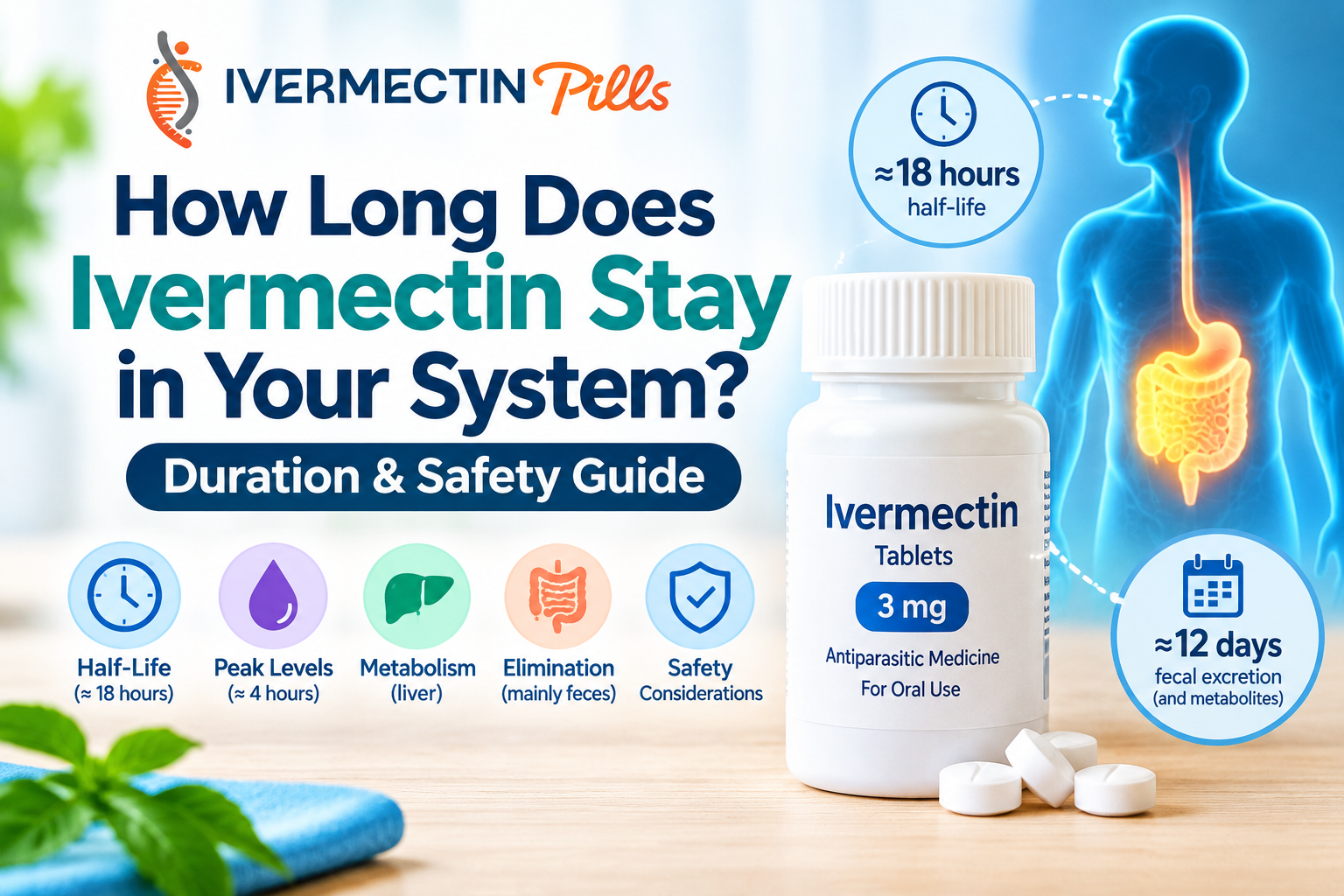
For oral ivermectin, prescribing information reports a plasma half-life of approximately 18 hours. After a single oral dose, peak plasma concentrations are reached at approximately 4 hours. Ivermectin is metabolized in the liver and is eliminated primarily through the feces, with less than 1% of the administered dose excreted in urine.
Understanding the difference between half-life, drug activity, and complete elimination can make this topic much easier to understand.
What Is Ivermectin?
Ivermectin is an antiparasitic medication used for certain infections caused by parasites. Oral ivermectin tablets are prescribed for specific conditions and should be used according to appropriate medical guidance.
The amount of ivermectin in the body changes after a dose. It is absorbed, distributed, metabolized, and eventually eliminated. These processes are collectively known as pharmacokinetics.
The time required for a medicine to leave the bloodstream is not necessarily the same as the time required for all drug-related substances to be completely eliminated.
How Long Does Ivermectin Stay in Your System?
For oral ivermectin, the reported plasma half-life is approximately 18 hours. This means that, on average, the amount of ivermectin in plasma decreases by about half over approximately 18 hours after reaching the relevant distribution phase.
However, a half-life should not be interpreted as meaning that the medicine is completely gone after 18 hours.
A simplified way to understand drug elimination is:
- After 1 half-life: approximately 50% remains
- After 2 half-lives: approximately 25% remains
- After 3 half-lives: approximately 12.5% remains
- After 4 half-lives: approximately 6.25% remains
- After 5 half-lives: approximately 3.1% remains
Using the approximately 18-hour plasma half-life as a simplified illustration, most of the parent drug in plasma would be substantially reduced over several days. However, individual elimination varies, and this calculation should not be used to determine when it is medically appropriate to take another dose.
When Does Ivermectin Reach Its Highest Blood Concentration?
Following an oral dose, ivermectin reaches peak plasma concentrations at approximately 4 hours in the pharmacokinetic studies described in U.S. prescribing information.
This does not mean that the medicine stops working after 4 hours. Peak concentration simply refers to the point at which the measured concentration in plasma is highest.
After the peak, the concentration gradually decreases as the body metabolizes and eliminates the medicine.
How Is Ivermectin Eliminated From the Body?
Ivermectin is metabolized in the liver. The prescribing information states that ivermectin and/or its metabolites are excreted almost exclusively in the feces over an estimated 12 days, while less than 1% of the administered dose is excreted in urine.
This distinction is important.
The 18-hour plasma half-life describes how quickly ivermectin concentration decreases in the bloodstream.
The approximately 12-day fecal excretion period describes the estimated period over which ivermectin and/or its metabolites may be eliminated in feces.
Therefore, saying that ivermectin is “gone after 18 hours” would be misleading.
Does Ivermectin Stay in Your Body for Days?
Small amounts of a medication or its metabolites can remain in the body after its concentration in the bloodstream has declined considerably.
For ivermectin, the elimination process can continue beyond the point at which blood concentrations have fallen substantially. The official prescribing information specifically reports fecal excretion over an estimated 12 days.
This does not mean that the same amount of active ivermectin remains in the bloodstream for 12 days.
It is important to distinguish between:
Blood concentration: How much parent drug is measurable in plasma.
Half-life: How long it takes for plasma concentration to decrease by approximately half.
Elimination: The broader process through which the medicine and its metabolites leave the body.
What Factors Can Affect Ivermectin Levels?
Drug levels and elimination can vary between individuals. Factors that may affect drug exposure include:
- Dose taken
- Whether doses are repeated
- Food intake
- Liver function
- Other medications
- Individual metabolism
- Age and general health
- The formulation being used
For example, current prescribing information reports that administration of ivermectin with a high-fat meal can substantially increase its bioavailability compared with administration in the fasting state.
Because of these differences, the half-life reported in clinical studies should not be treated as an exact countdown for every person.
Does Taking Ivermectin With Food Change Its Absorption?
Food can influence ivermectin exposure.
The prescribing information reports that administration of 30 mg ivermectin following a high-fat meal resulted in approximately 2.5 times greater bioavailability compared with administration in the fasted state.
This is one reason patients should follow the administration instructions provided for their particular prescription rather than changing how they take the medicine based on general information found online.
How Long Do Ivermectin Side Effects Last?
The duration of side effects can vary depending on the individual, dose, underlying condition, and whether other medicines are involved.
Possible adverse effects associated with ivermectin can include symptoms such as dizziness, nausea, diarrhea, fatigue, or other reactions. Some effects may be related to the underlying parasitic infection rather than directly to the medication.
If symptoms are severe, persistent, or unusual, medical advice should be sought rather than assuming that they will disappear once the drug leaves the bloodstream.
Can You Take Another Dose Before Ivermectin Is Completely Eliminated?
Do not use the estimated elimination period to decide when to take another dose.
Ivermectin dosing depends on the condition being treated and other clinical factors. Some treatment regimens involve a single dose, while others may require additional doses according to a healthcare professional’s instructions.
Taking additional ivermectin simply because symptoms continue or because you believe the first dose has “left your system” can result in inappropriate dosing.
Always follow the prescribed regimen.
Does Ivermectin Accumulate in the Body?
Accumulation can occur with repeated medication exposure depending on the drug’s half-life and dosing interval.
The prescribing information includes pharmacokinetic data from multiple-dose studies, but the appropriate regimen depends on the medical condition being treated.
Patients should therefore avoid modifying the frequency or amount of ivermectin without medical guidance.
Oral Ivermectin vs. Topical Ivermectin
It is important not to confuse oral ivermectin tablets with topical ivermectin products.
They have different routes of administration and pharmacokinetic characteristics.
For example, prescribing information for ivermectin cream reports a different apparent terminal half-life following repeated topical application.
Therefore, information about how long oral ivermectin tablets stay in the body should not automatically be applied to ivermectin cream or other topical formulations.
What Happens If Too Much Ivermectin Is Taken?
Taking more ivermectin than prescribed can increase the risk of adverse effects.
Symptoms associated with ivermectin toxicity can be serious and may include neurological effects. Anyone who believes they have taken more than prescribed should seek prompt medical advice or contact an appropriate poison-control service rather than attempting to calculate safety based on the drug’s half-life.
Do not take an additional dose to compensate for a missed dose unless a healthcare professional specifically instructs you to do so.
Frequently Asked Questions
How long does ivermectin stay in your system?
For oral ivermectin, the plasma half-life is approximately 18 hours. Ivermectin and/or its metabolites are eliminated primarily through feces, with excretion reported over an estimated 12 days.
How quickly does ivermectin leave the bloodstream?
Its plasma concentration decreases progressively after reaching peak levels at approximately 4 hours. The reported plasma half-life is approximately 18 hours.
Does ivermectin stay in your body for 12 days?
The approximately 12-day figure refers to estimated fecal excretion of ivermectin and/or its metabolites. It does not mean that the same concentration of active ivermectin remains in the bloodstream for 12 days.
Can I take another dose after 24 hours?
Do not determine dosing intervals solely from ivermectin’s half-life. The correct schedule depends on the condition being treated and the prescribed regimen.
Is ivermectin eliminated through urine?
Only a very small proportion of an administered oral dose is excreted in urine. The prescribing information reports that less than 1% is excreted in urine, with most ivermectin and/or metabolites eliminated through feces.
Read more: Why Does Scabies Itching Continue After Treatment? Causes & Recovery Tips
Final Takeaway
So, how long does ivermectin stay in your system? For oral ivermectin, the reported plasma half-life is approximately 18 hours, while ivermectin and/or its metabolites are eliminated primarily through feces over an estimated 12-day period.
The exact duration can vary between individuals and depends on factors such as dosing, repeated administration, food intake, liver function, and other medicines. Half-life information should be used to understand how the medicine behaves in the body—not as a tool for deciding when to repeat a dose.
Disclaimer: This article is for general educational purposes only and does not replace advice from a qualified healthcare professional. Ivermectin should be used only for appropriate medical indications and according to the directions provided by a healthcare professional. If you suspect an overdose or experience severe or concerning symptoms, seek urgent medical assistance.


